
“Computers are useless. They can only give you answers.” Pablo Picasso said that in 1964, decades before anyone typed a symptom into a chat window. The answers have gotten remarkably better since. However, the questions are still ours to ask.
And that has always been the hard part in healthcare. The hard part is no longer providing the right answer. It is asking the right question. As a family doctor, I can tell you that far too often my patients don’t know what to ask, or their questions themselves lead me away from their true need. Perhaps they are experiencing shame in discussing the issue. Or perhaps they don’t have the words to explain what is happening. Or perhaps it’s simply that they wish to be helped in a difficult time rather than to figure it out on their own.
I keep coming back to that as we watch a tidal wave of “ask AI”, “doctor in your pocket” and “personal health assistant” launches. Let me be clear: I am a staunch advocate for what these tools can do. It is a genuine shift for people to get answers at their fingertips without waiting three weeks for an appointment, and over the arc of time these tools will improve, becoming more proactive and more personalised.
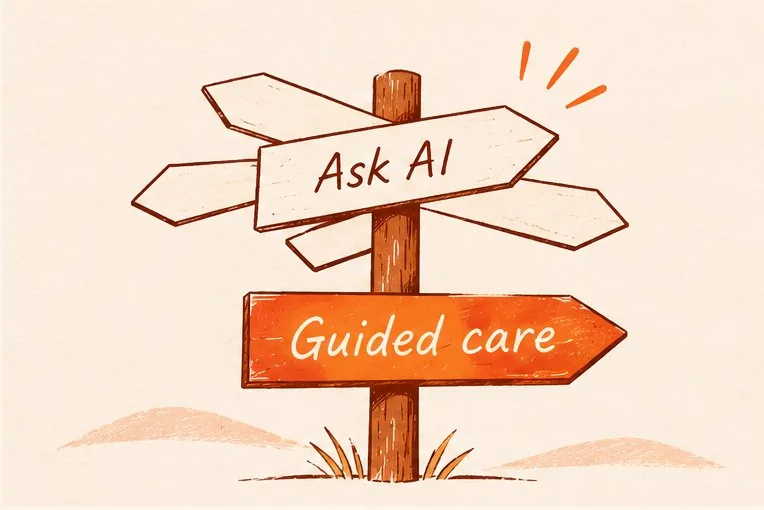
However, this does not detract from the fact that I feel we are not designing for the right problem, nor are we designing inclusively. We continue to think reactively. And while there is a place for people to get access to information and self-manage, a far more profound future involves purpose-driven solutions built toward a specific end outcome: a guided, expert care journey that helps the greatest number of people get to the best possible end outcome. That is designed very differently from a chatbot.
What are we designing for?
The end outcome we design for ultimately dictates what is built. Is the outcome simply to get people immediate access to information and to save time on questions being asked, or are we seizing the opportunity to think more boldly? Could these tools help us elevate standards of care, and even reimagine how we support people through complex behavioural and life changes? Are we truly designing to be inclusive of people of different ages, cultures, backgrounds, and socioeconomic settings, or are we generalising the rollout of tools on the basis of the digitally literate?
The evidence is already pointing this way. In February 2026, researchers at the University of Oxford published a randomised, preregistered study in Nature Medicine with 1,298 participants in the UK. Tested on their own, the large language models correctly identified the relevant condition in 94.9% of medical scenarios. When real people used those same models to work through the same scenarios, relevant conditions were identified in fewer than 34.5% of cases. More telling still, participants often did not know what information the model needed from them, and in one case two people describing near-identical symptoms of a brain haemorrhage were given opposite advice. If that is what happens with a general online sample, we should expect it to be worse for the people most often left out of design: older adults, those with lower digital or health literacy, and anyone for whom English is not a first language.
One part of the problem is that, generally speaking, what “support” looks like in the context of chronic disease is often poorly understood or practised. Behaviour change in the context of obesity, for example, gets reduced to something as simple as eat less, move more. This reductionist view oversimplifies the complexity of obesity: the impact of stress, the role of emotional eating, sleeping habits, the way a person’s day and life are designed, and how all of it may be quietly working against their metabolic health. These topics rarely surface in a search box from a patient. They surface when someone knows to ask.
But knowing what to ask is only half of it. Explaining the biology at the moment the person’s own experience makes it real is the other half. Even the highest-touch programs give people the biology, but it arrives as a module in week three, and the question that makes it click arrives in week seven. Anyone who has run a group session knows the binders: people arrive with every handout they have ever been given, flipping through pages to find the one that explains what happened to them this week. The information was right. The timing was off. A behavioural program should be able to answer “why did the scale go up after my best week?” with the explanation about water, glycogen and salt on the day it happens, in language the clinical team has already approved, because it knows where that person is in their journey.
The sycophancy problem
On top of this, the sycophantic tendencies of large language models work directly against behavioural change. These models are tuned to please the person in front of them, to answer the question that was typed, agreeably and at length. They’re tuned to keep you coming back. They are certainly not built to introduce friction.
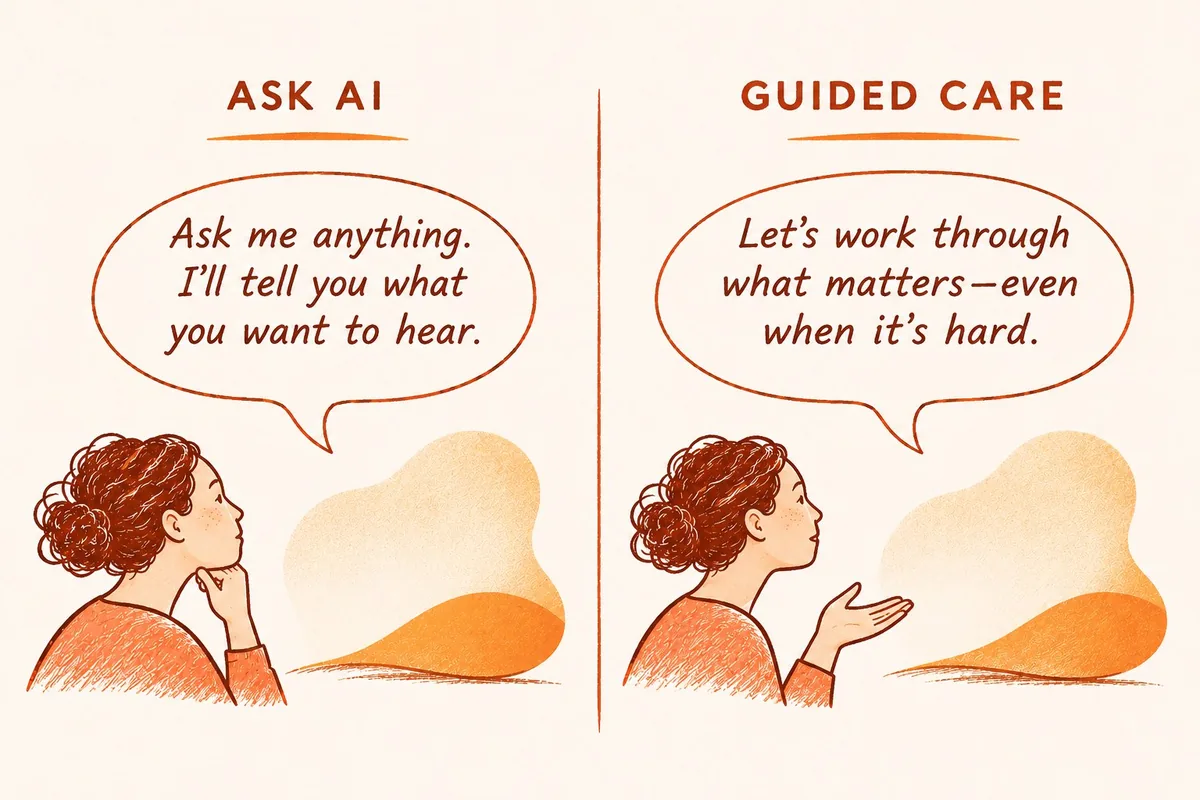
Now stop for a moment and imagine the opposite: an experience deliberately built to help people confront the things that are hard to talk about, or perhaps that didn’t even occur to them. Imagine that interaction not labelled or personified as a doctor, or even a therapist, but simply a “space” where someone can reflect on their fears, share their concerns, and be left with a tough idea to mull over. That is a real opportunity and one that technology today enables. But it has to be designed for.
Behaviour change often runs on friction. It is the check-in that the patient did not request, the “homework” they had to do, the hard fact delivered at an inconvenient moment, the nudge that is mildly irritating precisely because it lands. With the effective use of technology and purpose-built design, we can make this hard work not only scalable but, more importantly, more attuned to the needs of individual people and perhaps even more palatable.
Leave the patient to figure out how to best use the tool, and we have once again downloaded responsibility onto them. We have done this before in healthcare. We ask patients to fill out the same intake forms, repeatedly, in different places. We leave them with portals to follow up on what happens to a referral. “Patient empowerment” has too often been a sugar-coating of getting patients to do administrative work for the health system. To a certain extent, health-assistant chatbots risk repeating the same mistakes, all in the name of patient-centric care.
Still in the driver’s seat
nymble is not a chatbot. It is a clinically supervised behavioural program, and the difference between it and an “ask AI” assistant is the difference between two versions of the same trip. In one, you are handed the keys to a car in a city you don’t know, with a note on the dashboard that says “you can go anywhere.” In the other, you have the same car and the same city, but someone who knows the place like the back of their hand is in the passenger seat, saying “I know where you are trying to get to, and I know this city, so let me work with you to find the best path there.” You are still driving, but you are no longer alone.

That difference is not a feature. It is a design philosophy, and it depends entirely on who was in the room when the design happened.
Who is in the room
After 15 years of building digital health tools, I’ve seen the same pattern again and again: healthcare providers are barely involved in the build, if at all, and as technology rolls out faster, a “Chief Medical Officer” checkbox ticked as a token is becoming the norm. History tells us that solutions built by people who do not fundamentally understand what is happening in healthcare miss the mark on the problem. At nymble, I am proud to say that Megha (our co-founder and an endocrinologist) and I are steering the ship in the design of our products on a daily basis (while continuing to practise clinically part-time). Even more importantly, we are making sure we are tackling the right problems: the ones aligned with a person’s health needs, an organisation’s interests, and long-term, sustainable healthcare.
The future is at our doorsteps
To the organisations thinking about how AI fits into their patient journey: resist the urge to reactively oversimplify the deliverable to information support. Think about the problem you are designing for, what that journey actually looks like, where AI can be used effectively, and where it is excessive, so that we keep the human touch in healthcare. We should be elevating what is possible, not simply downloading work onto patients and discovering an entirely new wave of problems as a result.
The future is at our doorsteps. We simply need to help it through, with the right people in the room.
Let’s have this conversation in person
If you’re building in this space, or wondering whether you should be, come find us this month.
- Nov HLTH Las Vegas
- Nov Infoway Partnership Vancouver
- Nov Diabetes Canada Vancouver
For organisations: learn how nymble integrates into your care pathway at nymble.health/for-organizations
To learn more: reach out to us at hello@nymble.health
Dr. Puneet Seth is Co-founder and CEO of nymble health, a practicing family physician in Canada, and a serial digital health entrepreneur. nymble is building infrastructure for accessible and effective behavioural support for chronic diseases such as obesity.