
A patient sat across from me last month and said, "I think my body is just hungrier than other people's. That's not a thing I can control. But I'm lifting heavier weights than I ever have before. I feel stronger."
She had gained two pounds since our last visit.
That sentence was worth more than any number on her scale. It was, in clinical terms, one of the strongest prognostic indicators I see in practice - the cognitive shift from self-blame to self-understanding, paired with a behaviour she had genuinely made her own. She is going to do well long-term. I knew it the moment she said it.
But I had no way to measure it. No box to tick, no score to chart, nothing to put in a report to a payer or a pharma partner or a research collaborator that would let me say this is the signal that matters, and here is how we're tracking it.
That bothered me. Because if we can't measure it, we can't improve it, and we definitely can't fund it, scale it, or prove it works.
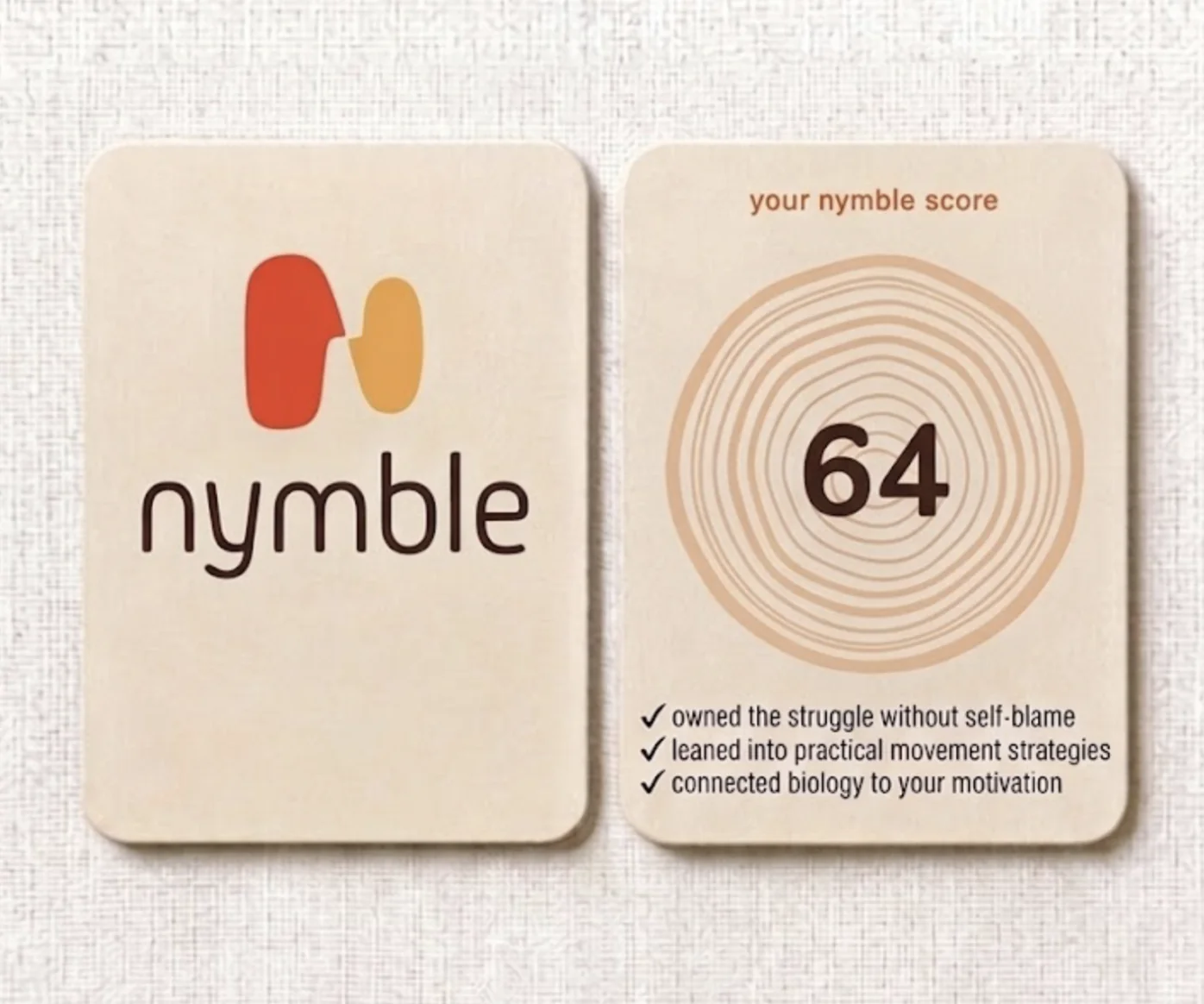
So we built what we believe to be the first behavioural measure of success on obesity treatment that lives inside the care itself, captured continuously, and longitudinally. It's called the nymble score.
In short: the nymble score is a longitudinal, conversational index of self-efficacy and behaviour change. It is calculated from three metrics grounded in established behavioural science, updates at clinically meaningful intervals, and feeds directly into the personalised support nymble delivers to every patient. It is not a questionnaire. It is not a wellness rating. It is a quantitative behavioural signal that can be tracked over months and years, in real-world care, at scale.
So far, what most programs have been measuring is wrong
For decades, the headline outcome in obesity care has been a single number: percent body weight loss. It's clean, it's reproducible, it's what regulators expect, and it's what every drug company in this space reports.
It is also a deeply incomplete picture of whether someone is actually doing better.
A few more real examples from our program data:
- A patient loses 7% of her body weight in six months but cancels her next appointment because her relationship with food has become more anxious, not less.
- A patient on tirzepatide stops the medication at month four, not because it isn't working, but because no one helped him understand the appetite shifts, and he interpreted normal satiety as broken.
Weight loss is a downstream proxy. It tells us something changed, but it doesn't tell us whether the underlying conditions for long-term success are in place - conditions like self-efficacy, behaviour change, and the cognitive shift from "I'm failing at this" to "I'm managing a chronic disease."
Take exercise. The data consistently shows that patients who exercise are better able to maintain weight loss long-term, and this holds true whether the weight was lost through medication, behavioural change, or surgery. It is, by some distance, the single best predictor we have of weight maintenance after weight loss.
But here's what the field has consistently glossed over:
"Telling someone to exercise is not the same as helping them become someone who exercises."
The exercise itself is the outcome of successful behaviour change, the visible end-product of a much harder, much less visible process underneath. The routine, the identity shift, the self-efficacy that comes from showing up for yourself week after week when nothing in your environment, your energy, or your history is pulling you in that direction - that is the actual work. And historically, we've left patients to do that work entirely on their own. We hand them the prescription ("exercise more") and almost no scaffolding for the process that would let them actually get there.
That's the gap. The exercise is the marker we celebrate. The behaviour change underneath it is the thing we've never properly equipped people for.
Why behavioural outcomes are so rarely assessed
There's a reason most obesity programs don't measure self-efficacy or behaviour change in any rigorous, quantitative way.
It's hard.
Patient-reported outcome questionnaires exist: the Weight Efficacy Lifestyle Questionnaire, the IWQOL-Lite, the Obesity-related Problems Scale. They are valuable instruments, but they're long, they're administered in a clinic or research setting, and they capture single snapshots. They were designed for trials, not for daily care. And, critically, they don't talk back. A score is taken, filed, and the patient never hears about it again.
Meanwhile, the behavioural science community has known for years what these outcomes should look like. The COM-B model, Capability, Opportunity, Motivation → Behaviour, has been the gold-standard framework for designing and evaluating behaviour change interventions since Michie and colleagues published it in 2011. The premise is simple: for behaviour to change, a person needs the capability to do it (knowledge, skills, the right mental model), the opportunity (an environment that makes it possible), and the motivation (the reflective and automatic processes that drive action). Anyone designing chronic disease support without these three pillars in mind is, frankly, designing in the dark.
What's been missing is a way to operationalise COM-B in real-world, longitudinal, scalable care. Not as a research instrument, but as infrastructure for care delivery.
That's precisely the gap the nymble score is built for.
What the nymble score actually is
The nymble score is a personalised, longitudinal index of self-efficacy and behavioural change. It is not a test. It is not a grade. It is not a leaderboard. It's calculated from three metrics, drawn directly from what behavioural science tells us actually predicts long-term success:
1. Self-reported wellbeing. How a person experiences their relationship with weight, eating, emotional health, and their own confidence to manage long-term. We baseline this at intake using four short questions and re-ask them at week 3, week 6, and monthly thereafter. Deltas matter more than absolutes.
2. Engagement. How a person shows up in conversation. Do they initiate? Do they come back after a quiet stretch? Do they ask the next question? Engagement is the single best behavioural correlate we have for whether someone will still be managing their disease a year from now.
3. Cognitive shift. How a person's language and framing are changing. Are they moving from "I just need more willpower" to "my biology is doing this and here's how I work with it"? That shift, captured directly from the words people use in real conversations, is the closest thing we have to a real-world measure of the capability dimension of COM-B.
Each metric is scored at regular, pre-specified check-ins that account for where an individual may be in their journey. The weighted composite produces points earned that period, which stack on top of what the user has already built. It works like XP. The score is a mirror, not a verdict.
Why this isn't another number to chase
I want to be clear about something.
"We're not in the business of replacing one tyranny, the scale, with another."
We did not build the nymble score so people would have another number to chase.
And we're acutely aware of what happens when you hand someone a daily number about themselves. Anyone who's worn a sleep tracker knows the feeling: the watch tells you that you slept badly, and suddenly you are tired, sluggish, foggy, more so than you would have been if you'd never looked. The score becomes the symptom. The measurement starts driving the experience instead of describing it. That's a well-documented phenomenon in the quantified-self literature, and it's a real risk in any behavioural product that surfaces a number back to a user.
The nymble score is deliberately not built to function that way. It is not a daily verdict. It is not a performance grade. It is not something a user is meant to wake up and check, feel good or bad about, and carry into their day. It updates at clinically meaningful intervals, not constantly, and it is framed to the user as what it actually is: a directional compass. A way of seeing, over weeks and months, where the work is paying off and where the next opportunity lies. Not a motivator for today. A map for the long arc.
The score is not the point. What we do with it is.
The reason we built it was because we needed something to feed into the engine.
nymble runs on a personalised automated agent that adapts every conversation to where a user is - biologically, emotionally, and cognitively. The score is the structured signal that drives that personalisation. When a user's emotional dimension is low, we lead with validation before education. When their cognitive shift is moving fast, we challenge them with deeper content. When engagement dips, we re-engage them not with a generic "hey, you there?" but with a reference to the experiment they were running last time.
In other words, the score isn't shown off. It's used. It's the substrate underneath every personalised message, every action item, every nudge that powers the movement towards meaningful behaviour change. The number a user sees is the surface; the engine that runs on it is the substance.
This is also where we differ from most digital health products.
"Most tools collect data to report on people. nymble collects data to respond to them."
The score isn't a dashboard for us. It's a feedback loop for them.
Why we think this will actually work
Building a measure is easy. Building a measure that moves is the hard part, and that's where most of the field has stalled.
The reason we believe nymble can move it is because we've solved the unfair half of the equation first: engagement.
Across more than 25,000 conversations, in five countries, in multiple languages, on the channels people already use (SMS and WhatsApp), nymble achieves engagement rates that look nothing like a typical digital health app. Most people come back. They ask harder questions over time. They send messages on Sunday nights and Tuesday afternoons. They re-engage after going silent. We've earned a level of presence in patients' lives that most apps spend years failing to manufacture, because we didn't ask them to download anything, log in, or change their behaviour just to access ours.
That engagement is the prerequisite for everything else. Behavioural support that nobody opens is, charitably, a placebo. The most beautifully evidence-based curriculum in the world is worthless if it sits on a PDF, in a downloaded folder, or displayed on a mobile app that people log into once.
That's the bet we're making. A high-engagement channel, a clinically grounded, proprietary behavioural program built with authors of the Canadian Obesity Clinical Practice Guidelines, and a measurement system informed by patient experience and years of empathic clinical practice that actually captures the dimensions behaviour change theory says matter: capability, motivation, and the supportive opportunity our program creates.
What's next: proving it
We've done the building. Now we're doing the proving.
We're actively enrolling users every day. As we get to scale, we're running the analyses we've been waiting for: does the nymble score, tracked longitudinally, predict the outcomes we actually care about? Medication persistence at six and twelve months. Reductions in internalised weight bias. And whether sustained engagement past the early honeymoon translates into the clinical and metabolic outcomes the field has long been chasing.
The early signs are encouraging. In recent weeks, abstracts and pitches we've put forward, to the American Diabetes Association's Innovation Challenge, the Web Summit Vancouver Impact Program, the EASO/ECO Congress, and the IFA Innovation Prize, have been recognised.
Each platform has its own bar, and clearing all of them in the same window suggests the work is resonating beyond our own conviction. We'll have more to say at each of these as the year unfolds.
We're working with leading academic collaborators to publish this in the open, peer-reviewed literature. Because if we want self-efficacy and behaviour change to be taken seriously as outcomes in chronic disease care, funded, prescribed, and integrated, we need to hold ourselves to the same standard as any clinical intervention.
Real-world data, real-world behaviour, real-world lived experience. That's exactly what the WHO called for in its recent global guidelines on GLP-1 therapy. And that's what we're building toward.
Because if we keep measuring obesity care by the scale alone, we'll keep getting answers that don't reflect whether people are actually doing better. And the people quietly doing the hardest work, the ones rebuilding their relationship with their bodies one conversation at a time, will keep being invisible to the system that should be celebrating them.
The nymble score is our attempt to make them visible.
That work doesn't happen in isolation. If you're working on this problem, from inside a health system, a payor, a research group or other stakeholder, we'd love to hear from you. Contact us at [email protected].
If you are a patient looking for support on your weight management journey, find out more here.